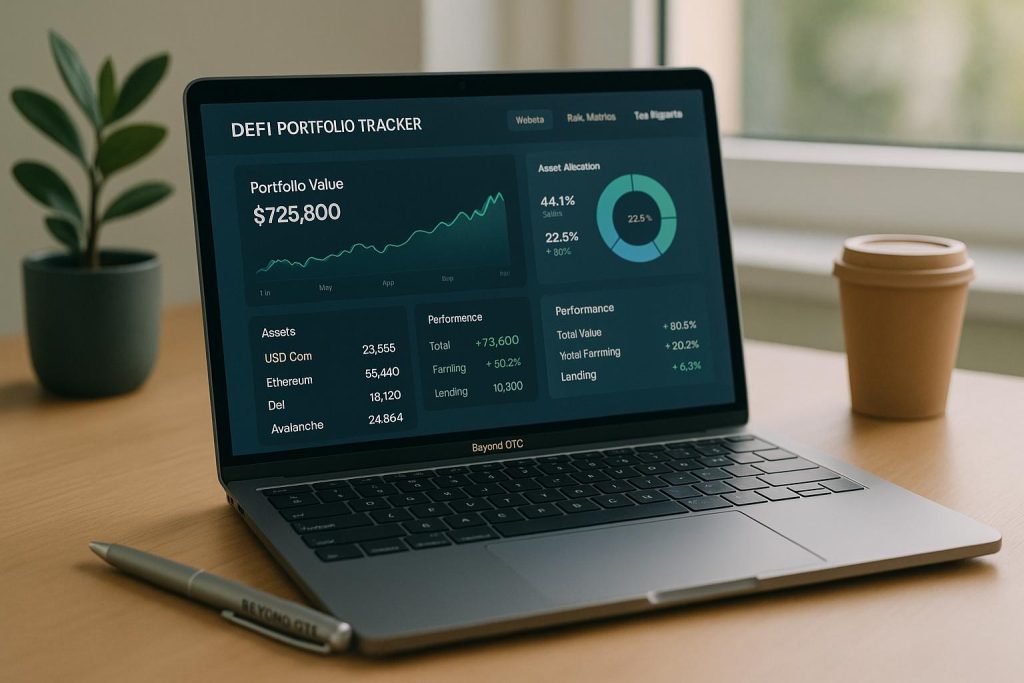
Managing DeFi investments can be overwhelming. Your assets are often spread across multiple blockchains, protocols, and wallets, making it hard to get a clear picture of your portfolio. Traditional wallet balances don’t account for real-time fees, rewards, or risks like impermanent loss. That’s where DeFi portfolio trackers come in – they simplify tracking, risk management, and performance analysis.
Here’s a quick breakdown of what you should look for in a tracker:
- Multi-Chain Support: Consolidates assets across blockchains like Ethereum, Arbitrum, and Solana.
- Real-Time Analytics: Updates balances, APYs, and performance metrics instantly.
- Risk Management: Monitors liquidation risks, impermanent loss, and protocol health.
- Security: Non-custodial, read-only access to protect your private keys.
- Tax Reporting: Exportable transaction histories in USD for compliance.
Popular tools like DeBank, Zerion, Zapper, APY.vision, and Nansen offer features tailored for different needs, from tracking liquidity pools to analyzing wallet activity. Whether you’re a casual investor or managing institutional-level funds, these tools help you stay on top of your DeFi strategies and risks.
How to Track Your DeFi Portfolio with Zerion
What to Look for in DeFi Portfolio Trackers
Navigating the complexities of decentralized finance (DeFi) requires tools that do more than just compile data – they need to actively help manage risk and provide actionable insights. The best portfolio trackers bring together data from multiple platforms, update it in real time, and highlight potential risks. Here’s what you should prioritize when choosing a tracker for your DeFi investments.
Multi-Chain and Multi-Wallet Support
DeFi activities rarely stick to just one blockchain or wallet. You might lend assets on Ethereum, farm yields on Arbitrum, stake tokens on Polygon, or experiment with protocols on Solana – all while juggling multiple wallets. Without a system to bring all this data together, tracking your overall portfolio can become a headache.
A good tracker should automatically detect and consolidate assets from all your public wallet addresses across different blockchains. Many modern platforms support over 120 blockchains, 300 wallets, and 1,000 protocols, offering a unified dashboard that converts your holdings into USD values (e.g., $25,000.50). This makes it easy to see everything in one place, whether it’s Ethereum mainnet positions, Layer 2 assets like those on Arbitrum, or holdings on alternative chains like Avalanche or the BNB Chain.
It’s not just about showing balances, though. The tracker should also recognize cross-chain positions accurately. For example, if you’ve bridged USDC from Ethereum to Arbitrum and then deposited it into a lending protocol, the tool should avoid double-counting your assets. Similarly, it should handle wrapped tokens properly, ensuring your exposure is calculated correctly.
Another handy feature is the ability to tag and label wallets. Whether you use one wallet for trading, another for staking, and a third for testing new protocols, being able to label them as "Trading", "Staking", or "Testing" helps you organize your portfolio. Platforms like Nansen have even labeled over 500 million wallets to enable smarter tracking and analysis.
For U.S.-based investors managing multiple wallets – or institutions handling large-scale investments – having a consolidated view is essential. It simplifies decision-making, helps manage risk, and ensures accurate reporting to stakeholders. Aggregated data also makes it easier to monitor mandates, rebalance portfolios, and avoid overlooked positions.
Real-Time Analytics and Performance Metrics
In DeFi, having up-to-date information is critical. The best trackers pull data straight from the blockchain, ensuring balances, transaction statuses, and APY changes are updated in real time. This way, your decisions are always based on the latest market conditions.
Beyond simply showing your total balance, advanced trackers provide detailed performance analytics. They calculate both realized and unrealized profit and loss (PnL), break down gains by asset or protocol, and display historical performance trends over different timeframes – daily, weekly, monthly, or yearly. Some even offer time-weighted or money-weighted returns to help you evaluate whether your active strategies are delivering better results than a basic buy-and-hold approach.
DeFi-specific metrics take things a step further. Instead of just listing token balances, top-tier tools display key metrics like fees, impermanent loss, and liquidation risks. They also detect positions across lending, borrowing, liquidity pools, staking, and farming, calculating your net APY after accounting for fees and impermanent loss.
Trackers that show trends in total value locked (TVL) by protocol and chain can provide additional insights. Metrics like protocol fees, trading volume, and active user counts help you identify sustainable yield opportunities and avoid short-lived schemes. For those managing larger portfolios, incorporating tracker data into your routine – whether daily or weekly – can lead to smarter rebalancing decisions.
Risk Assessment and Security Features
Managing risk is just as important as tracking performance in DeFi. While the potential for high returns is enticing, the risks – like smart contract vulnerabilities, liquidation events, and protocol failures – are real. A reliable tracker should help you stay ahead of these challenges.
For liquidity positions, trackers should model impermanent loss against fees to give you a clear picture of your actual gains. For lending and borrowing, real-time monitoring of health factors, loan-to-value (LTV) ratios, and collateral levels is crucial. A good tracker will show your liquidation threshold and simulate how price changes – like a 15% drop in ETH – could impact your positions, allowing you to act before liquidation becomes a risk.
On the protocol level, trackers should provide insights into TVL changes, past incidents, audit statuses, and available insurance options. Some platforms, like De.Fi, even combine portfolio tracking with tools like a "crypto antivirus" that scans for known exploits in connected contracts, flagging potential risks before you interact with them.
Security and privacy are equally important. For U.S. investors, non-custodial trackers that don’t require private keys or seed phrases are the safest option. The best tools use read-only connections via public wallet addresses or API keys, ensuring you can monitor your portfolio without exposing sensitive information. Strong encryption, audited code, and clear security protocols – such as bug bounty programs – are additional features to look for.
Finally, consider tools that simplify tax and compliance. For U.S. users, trackers that provide USD-denominated transaction histories with clear timestamps (using MM/DD/YYYY format) can make tax reporting much easier. Exportable CSV files and integrations with crypto tax software can help you organize data for year-end filing. Detailed logs of swaps, staking rewards, and liquidity pool transactions also make it easier to distinguish between capital gains and ordinary income – critical for accurate tax preparation.
DeFi Portfolio Tracking Tools
When diving into DeFi, having the right portfolio tracker can make all the difference. Whether you’re looking for multi-chain compatibility, liquidity insights, or advanced analytics, there’s a tool tailored to your needs. Here’s a breakdown of some popular options and what they bring to the table.
DeBank
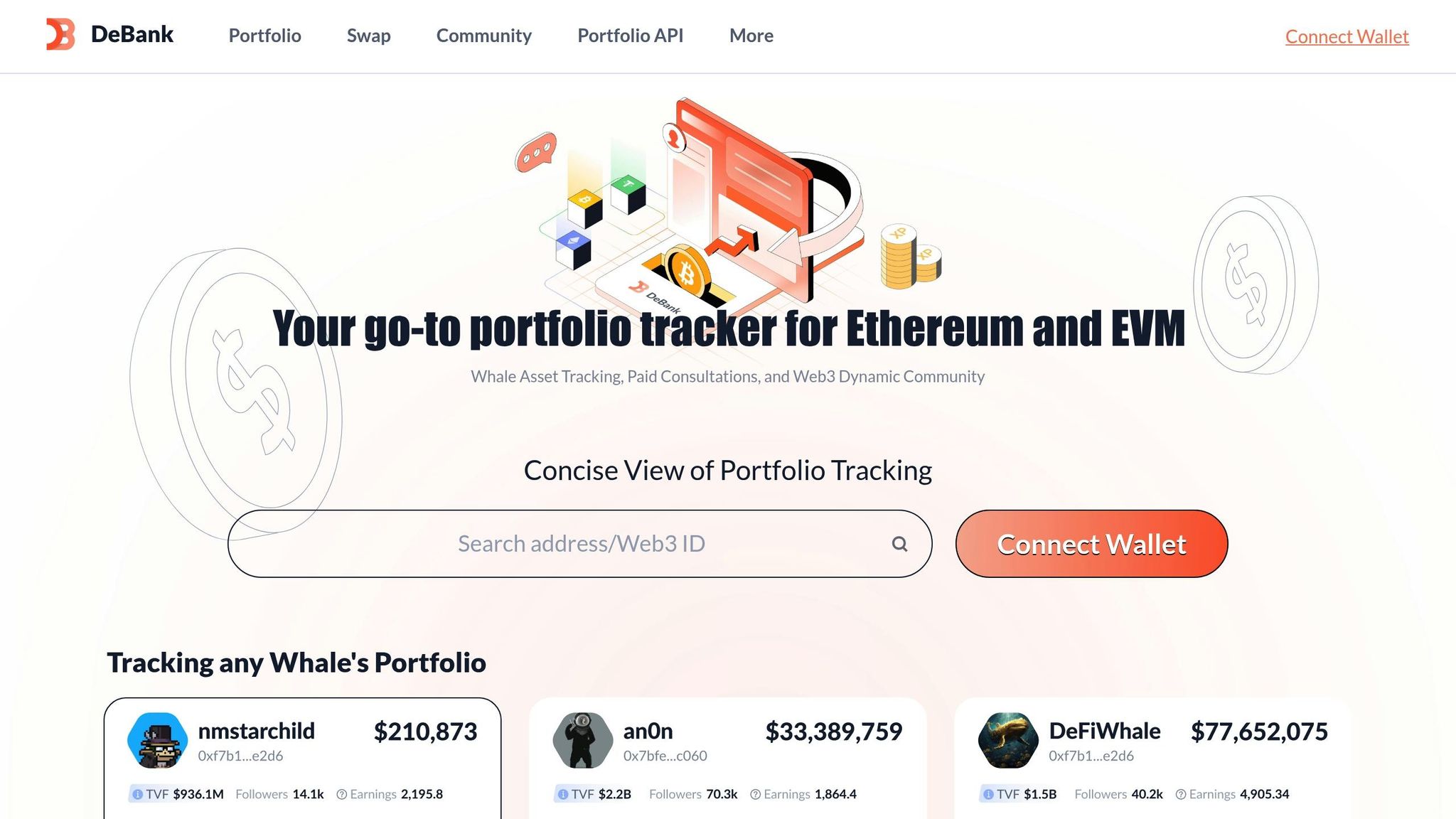
DeBank is a multi-chain portfolio tracker that consolidates everything from lending and liquidity pools to staking and yield farming into a single, user-friendly dashboard. It calculates your total portfolio value in U.S. dollars and categorizes assets for a clearer overview. With its ability to detect active positions across numerous protocols, DeBank is a reliable choice for keeping tabs on a wide range of DeFi strategies.
Zerion
Zerion takes portfolio tracking a step further by integrating transaction management. Supporting a variety of protocols across multiple blockchains, it automatically identifies positions in lending, borrowing, liquidity, and yield farming. Zerion also lets you swap tokens, bridge assets, and interact with DeFi protocols – all directly from its platform. Its secure, read-only mode until you initiate a transaction ensures a smooth and safe user experience.
Zapper
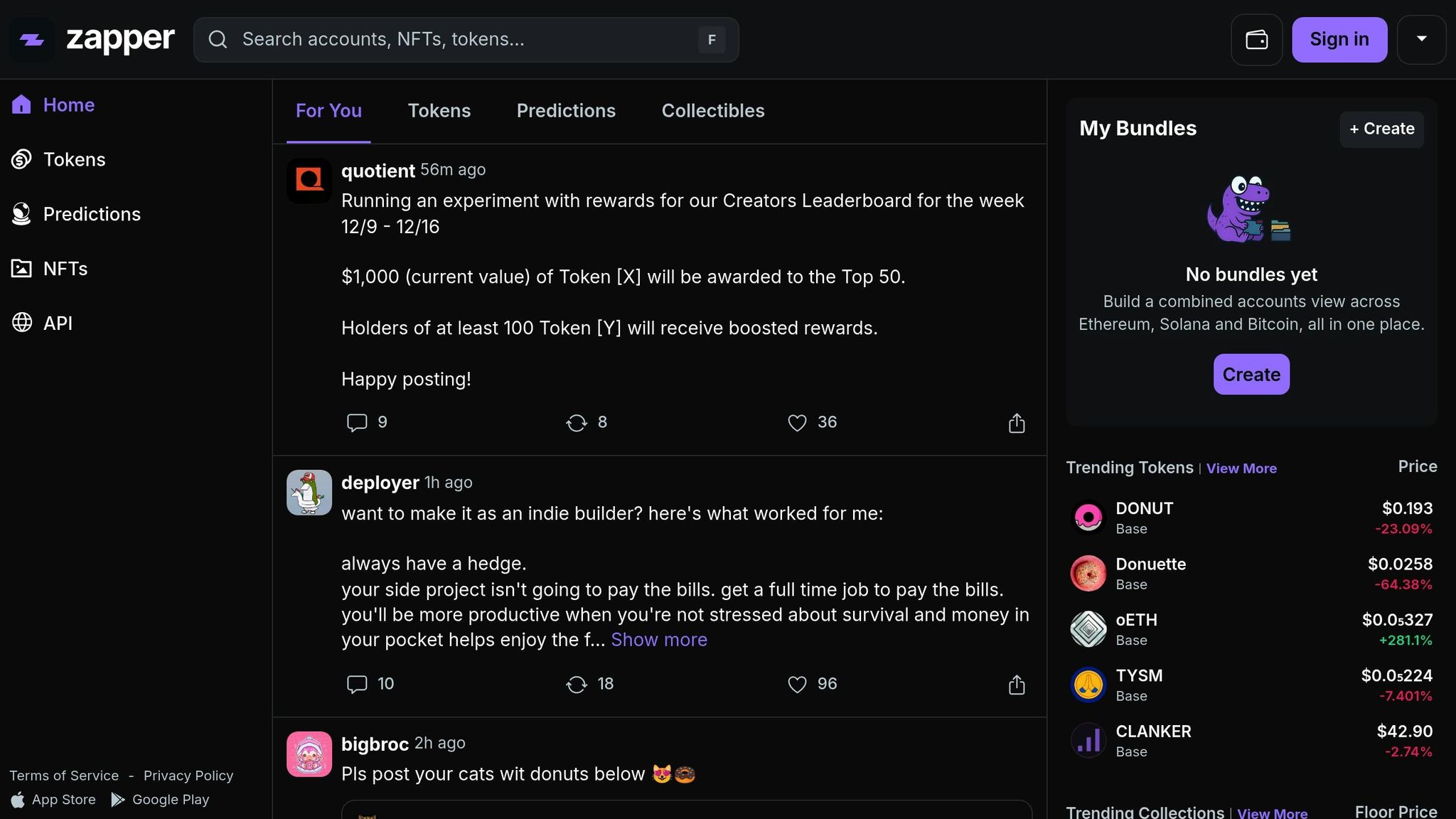
Zapper simplifies DeFi portfolio management by aggregating your positions and displaying them in an easy-to-digest format. It pulls data from multiple protocols, breaking down your portfolio by asset type and strategy. Its standout "Zap" feature condenses complex multi-step transactions into a single action, saving both time and fees. The dashboard also includes visual tools to track portfolio growth, offering a straightforward way to manage multiple positions.
APY.vision
APY.vision is tailored for those focused on liquidity pools. It tracks critical metrics like fees, impermanent loss, and overall returns, helping you assess whether providing liquidity outperforms simply holding the assets. The platform allows side-by-side pool comparisons and provides alerts for significant performance shifts, ensuring you can make timely and informed decisions.
Nansen

Nansen goes beyond basic portfolio tracking by combining it with wallet analytics and on-chain intelligence. It categorizes wallets to spotlight activity from influential investors and contextualizes your portfolio by comparing it to market trends and protocol performance. Its dashboard offers insights into user activity, transaction flows, and capital movements, making it a powerful tool for spotting emerging trends. Customizable alerts for major wallet activities add an extra layer of strategic advantage for those wanting a deeper dive into DeFi dynamics.
sbb-itb-7e716c2
How to Use Portfolio Trackers in Your DeFi Investment Strategy
Incorporating portfolio trackers into your daily investment routine can provide you with actionable insights that help you make smarter decisions. By consistently monitoring and analyzing data, you can fine-tune your DeFi positions and respond to changes effectively.
Daily Monitoring and Position Review
Start your day by reviewing your portfolio tracker to assess your overall investment health. A structured approach ensures you catch critical shifts before they become major issues. Here’s what to prioritize:
- Evaluate overall portfolio performance across all chains and protocols to spot trends in your total value.
- Check alerts for key events like TVL (Total Value Locked) drops, significant APY (Annual Percentage Yield) fluctuations, or flagged security issues that need immediate action.
- Analyze top positions by examining metrics like TVL trends, user growth, and revenue generation to gauge protocol stability.
- Monitor collateral ratios in lending protocols and pay attention to alerts when nearing liquidation thresholds.
- Identify underperforming positions that show declining metrics or increased risk signals.
Configuring alerts within your portfolio tracker is crucial. Set up multi-tiered alerts to stay ahead of potential problems. For example, use primary alerts for TVL changes of 15-20%, secondary alerts for APY shifts over 25%, and collateral health alerts when nearing 70% of the liquidation threshold.
Using Analytics to Optimize Strategy
Portfolio trackers provide the data you need to evaluate and refine your investment strategies. Whether you’re holding, staking, or providing liquidity, focus on these three areas:
- Compare real APY across strategies. Look at historical APY trends over at least 30 days instead of chasing pools with unsustainably high yields. For example, if a position’s APY drops from 45% to 12% over 60 days while TVL remains steady, it could signal the protocol is reaching equilibrium.
- Assess impermanent loss risk. Keep an eye on pool depth and fee generation rates. Calculate whether the fees earned are enough to offset potential impermanent loss, especially in volatile markets.
- Examine revenue distribution models. Determine how fees are allocated – what percentage goes to token holders versus being retained by the protocol. This can reveal the protocol’s long-term sustainability. Also, track how different protocol types perform under various market conditions.
Use your portfolio tracker’s performance comparison tools to rank your positions by ROI (Return on Investment). Compare individual gains against your portfolio average and relevant benchmarks. You can also create a rebalancing scorecard that tracks each position’s current APY, historical APY, TVL trends over the past 30 days, revenue generation, and security audit status. Advanced features allow you to overlay your portfolio’s performance with major market indicators like Bitcoin and Ethereum, helping you identify correlation patterns over time.
For example, BeyondOTC has applied this systematic approach to optimize their clients’ portfolios, successfully directing over $40 million into DeFi TVL through real-time analytics and strategic adjustments.
Data Export for Tax and Reporting
Exporting your transaction history regularly is essential for staying compliant with tax regulations and tracking performance. At least once a quarter, download all records of deposits, withdrawals, yield farming rewards, staking rewards, token swaps, and realized gains or losses, along with their USD values at the time of each transaction.
Most portfolio trackers offer CSV export options that include wallet addresses, transaction hashes, and protocol names. These files can be easily integrated with tax software, saving you from manually reconciling data across multiple wallets and protocols. Additionally, take monthly portfolio snapshots to document each position’s cost basis, current value, unrealized gains or losses, and associated protocol.
Accurate records are critical because each yield farming or staking reward is considered a taxable event. Factors like impermanent loss may also have specific tax implications. Using built-in export tools simplifies tax reporting, reduces errors, and ensures you have comprehensive documentation for year-end filing and stakeholder reporting.
Conclusion
Portfolio tracking tools have grown from simple dashboards into essential resources for managing DeFi investments. With the DeFi landscape spread across more than 100 blockchains and thousands of protocols, these tools simplify the chaos of on-chain data, turning it into actionable insights. They help evaluate protocol health, spot risks, and identify opportunities – often before price movements reveal them.
Platforms like DeBank, Zerion, Zapper, APY.vision, and Nansen offer a unified view of multi-chain positions. By tracking metrics such as Total Value Locked (TVL), user growth, revenue, and liquidity depth, these tools provide the clarity needed to assess protocol stability and make smarter capital allocation decisions. Their evolving features also enable more advanced tracking for risk management and yield optimization.
When it comes to risk, these tools make it easier to identify vulnerabilities early. By monitoring factors like code audit status, insurance coverage, historical incidents, and collateral ratios, you can evaluate a protocol’s safety before committing funds. During market downturns, analytics platforms can flag warning signs – like sharp TVL drops or declining user metrics – well before a protocol collapses. This early insight gives investors the chance to exit and protect their capital.
For yield optimization, these platforms go beyond tracking returns. They help uncover hidden costs and rank positions by return on investment (ROI). Comparing your portfolio’s performance against major market indicators allows for continuous improvement and strategic rebalancing.
Additionally, regular CSV exports simplify compliance and tax reporting by providing accurate, USD-denominated transaction records – streamlining what can otherwise be a tedious process.
For institutional investors, combining these tools with expert advisory services like BeyondOTC’s Institutional TVL Solutions can further enhance risk management and capital deployment strategies. BeyondOTC has facilitated over $40 million in DeFi TVL by blending systematic portfolio monitoring with strategic guidance. Their approach, which includes smart monitoring, protocol risk assessments, and APY optimization, has helped clients raise over $5 billion, demonstrating how institutional-grade analytics can drive returns while managing risk effectively.
To navigate the complexities of DeFi successfully, a best-practice approach includes using a multi-chain tracker for daily visibility, advanced analytics for liquidity strategies, and export features for compliance. As DeFi continues to expand across new chains and protocols, the investors who thrive will be those leveraging comprehensive tools – combining real-time analytics, security insights, and multi-chain support – to make informed, data-driven decisions.
FAQs
How do DeFi portfolio trackers manage assets across different blockchains and wallets?
DeFi portfolio trackers leverage powerful integrations and APIs to pull together data from multiple blockchains and wallets. By connecting to various wallets and protocols, they give you a single, streamlined view of your holdings. This means you can monitor balances, transactions, and performance all in one convenient place.
Many of these tools also offer cross-chain compatibility, which is a game-changer for tracking assets on major blockchains like Ethereum, Binance Smart Chain, and Polygon. So, even if your investments are scattered across different platforms, these trackers make it easy to stay on top of your portfolio’s total value and performance.
What key security features should I consider in a DeFi portfolio tracker to protect my investments?
When selecting a DeFi portfolio tracker, it’s crucial to focus on security features that protect your investments. Prioritize tools that offer two-factor authentication (2FA), data encryption, and secure API integrations to keep your personal and financial information safe from potential breaches.
It’s also wise to choose trackers that have been audited by well-known firms or provide clear and transparent security practices. Avoid platforms that require access to your private keys, as this reduces the chances of unauthorized access to your funds. Always take the time to confirm the authenticity of the tracker before linking it to your wallet or accounts.
How do portfolio trackers help with tax reporting and staying compliant for DeFi investments?
Portfolio trackers make handling taxes for DeFi investments much easier by automatically pulling together transaction data from multiple wallets, platforms, and protocols. They calculate things like capital gains, losses, and income from activities like yield farming or staking, ensuring your tax reporting stays accurate.
Many of these tools also create detailed reports that align with U.S. tax requirements, simplifying the process of filing and staying on the right side of IRS regulations. By keeping your transaction history well-organized and easy to access, portfolio trackers save you time and help minimize mistakes when tax season rolls around.